The State's signature, not an opinion on a photo.
We open the chip of the electronic identity card and the passport, and verify on our own server the signature of the State that issued them. When there is no chip, we say so in the result instead of pretending it is the same thing.

Case outcome
ver_7f3a91c4
- Document
- Electronic identity card
- MRZ check digits
- All add up
- Tax code
- Recomputed from the MRZ
- Liveness
- Passed
- Face similarity
- 96 / 100
- Issue date
- To be confirmed
Compliance
ISO/IEC 27001:2022
GREM S.R.L.'s information security, covering the development and production of SaaS solutions
ours
ISO/IEC 27017:2015
Security controls for cloud services, an extension of GREM S.R.L.'s 27001
ours
ISO/IEC 30107-3
Anti-spoofing, Levels 1 and 2, NIST-accredited laboratory
liveness component
GDPR
The customer is the controller, we are the processor. Appointed under Art. 28
compliance
Data in Ireland
Document, face and images on AWS in Ireland, eu-west-1. Anyone else who touches the data is listed on the sub-processors page
architecture
Four checks, and nothing else
Front and back must belong to the same card: the comparison is only possible because one of the two sides is certain.
We read the result from the service ourselves. What the browser claims is not proof: a client that certifies its own success is a client an attacker controls.
It stops the most common fraud, the one liveness alone is blind to: a real person showing someone else's document.
The provider returns a binary result, and for a common surname it comes back with sixteen namesakes. The score that ranks them is ours, and no threshold removes a hit from the table: a sanctioned person dismissed by a number we made up ourselves is not something you can explain to a supervisory authority.
What we don't do. No verification of legal entities, no transaction monitoring, no risk profiling. No search for a face among other customers' faces: verification is always one-to-one, and that keeps the system outside Annex III of the AI Act. On the lists we give you the hits and their assessment: the customer due diligence decision stays with your institution.
How it works
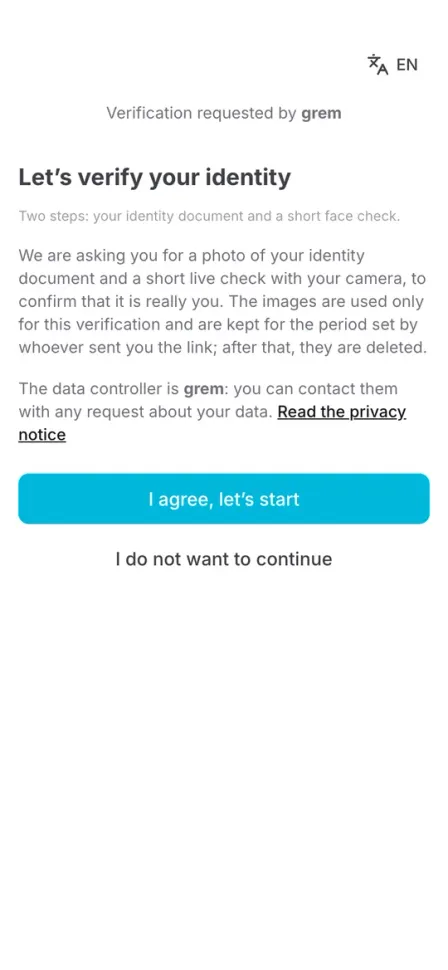
01 Consent
Who is asking, why, and who the data controller is: before any photo
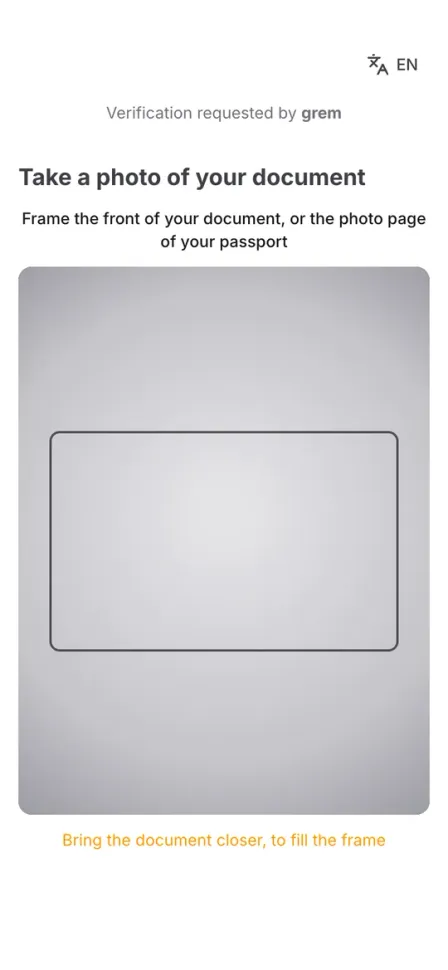
02 The document
The camera takes the shot by itself when it is in focus
03 The chip
Hold the document to the phone: we read the State's signature
04 The face
A live person, compared with the signed portrait
Consent and document are real screens of the verification page. Chip and face are drawn: capturing them would take a real document and a real face.
- 1
Open the case and mint the link
From the dashboard or with an API call you create the verification, then mint a single-use link that expires. They are two separate resources: the case lasts and carries the decision, the link does not.
A link that is generated and never opened is not charged.
- 2
The person verifies
They open the link on their phone, give consent — recorded with date, text version and IP address — photograph the document and pass the liveness check.
No account to create. Reading the chip requires our app: no browser can talk NFC to a document, and on iOS it is simply not possible.
- 3
The automated checks
Document reading, check digits, liveness and face match. What the person can fix — a blurry photo, a glare, the back of a different card — comes back straight away, saying what to redo.
If one of our checks is unreachable we say so, and we tell them without blaming their document: the attempt remains valid and nothing is charged to you.
- 4
A person decides
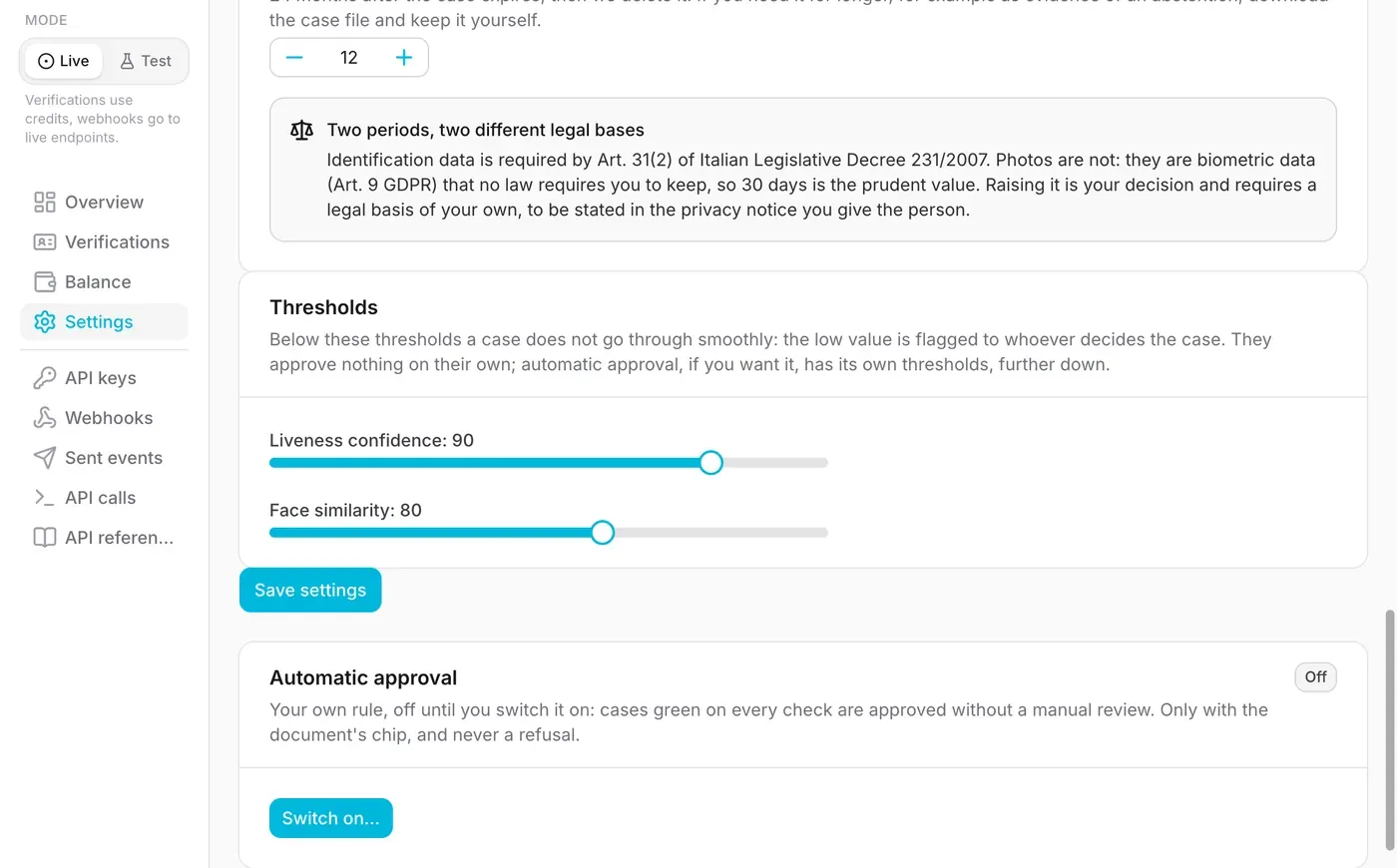
Your team — or one of our operators, on the Institutional plan — looks at the document and the face side by side and picks the reason from a closed list. If you switch on automatic approval, cases green on every check are approved on their own: with the chip, or from the photograph too if you choose to accept its limits; refusals always stay with a person. The outcome reaches your signed webhook and stays readable via the API.
Every time a case is opened, it is recorded in an access log.
Retrying means minting a new link on the same case: the previous one dies.
"Expired" and "needs a retry" also arrive as events: you don't have to poll to find out.
Who it's for

Why trust the result
Evidence
Liveness
99.6 / 100
Face similarity
97.4 / 100
Identity
- Surname
- ROSSI
- Given name
- MARIO
- Date of birth
- 14/03/1985
- Tax code
- RSSMRA85C14F839K
- Place of birth
- Napoli (NA)
- Document number
- CA12345XY
Lists
ROSSI MARIO GIUSEPPE
EU Consolidated
ROSSI M.
PEP — Italy
No hit is hidden by a threshold.
Check digits are arithmetic, not a guess
The machine-readable zone carries ICAO check digits: if the reading is wrong, the numbers don't add up — instead of arriving as plausible, false data. That is why we tell a proven field apart from a field that was only read, and tell you which is which.
In practice
On a real card the surname read from the front was "BRNV" — the vertical text of the hologram. The MRZ on the back said "ROSSI".
A person decides every refusal
No refusal comes from a machine. Whoever decides — your team, or one of our operators on the Institutional plan — sees the document and the face side by side and picks the reason from a closed list: no free-text boxes on data that is kept for years. Only if you choose it, cases green on every check are approved without review by a person — with the chip signed by the State or, if you accept that separately, from the photograph alone too — and the case says that is how it went.
In practice
The role that accesses biometric data is separate from everything else, so it can be revoked on its own. Every time a case is opened, it is recorded in a log the customer cannot delete.
Data stays in Europe
Processing on AWS in Ireland, region eu-west-1, and the application in Germany; only the name goes to screening, in Switzerland, a country with an adequacy decision. We don't train models on customer data: it would make us a controller and we would need our own legal basis for biometric data.
In practice
Document photos and liveness frames live on a short clock: they die when the case is closed and in any case within 30 days of capture, even if the case was abandoned.
We don't ask you to trust a score: every case carries the thresholds in force that day, who decided — your team, one of our operators or your automatic approval rule — and the reason chosen from a closed list. That is what you need to answer a supervisory authority six months from now.
Where our job ends
What we do
- We perform the technical verification: document reading, liveness, face match.
- We return the data read, the outcome and the measurements that make it reproducible six months from now.
- We retain data according to the setting you choose, within a maximum set by the product.
- We act as processor under Art. 28 GDPR, with declared sub-processors.
What stays with your institution
- You are the obliged entity: technology providers do not appear in the list in Art. 3 of Italian Legislative Decree 231/2007.
- You decide customer due diligence and the risk profile. Our outcome is one input, not the decision.
- You choose how long to retain and tell us when the relationship ends: the clock starts from there, and you are the one who knows that date.
- You offer the non-biometric alternative on your own channels — SPID, qualified electronic signature, in-person identification.
We don't say "we do KYC for you", because it isn't true and it shows immediately in a due diligence. We don't issue the Art. 27 attestation and we never decide an erasure request: we forward it to the controller, which is you.
Pricing
A link never opened is free
You pay when the person completes the verification, not when you generate the link.
Retrying does not charge twice
Each module is paid once per case: a second attempt is not a second verification.
A refusal is charged
It is still work done: the document was read, the face compared, the lists queried.
From €0.33 per verification, at most €0.68 with chip and screening. Top up your balance by card and use it whenever you like; human review by our operators is in the Institutional plan.
See prices and plansTwo calls to get started
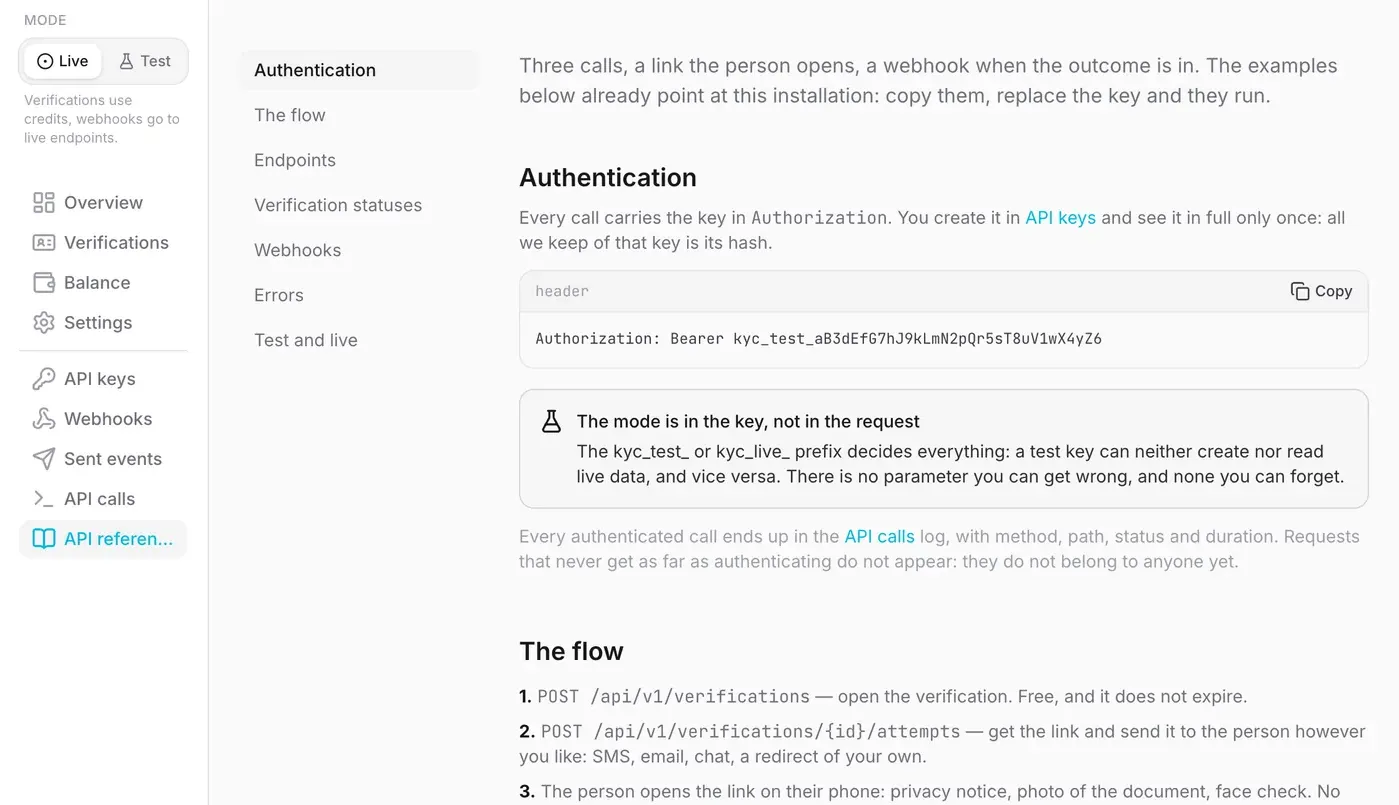
POST /api/v1/verifications
  → { "id": "01994c1e-9d33-7b4e-8a12-6c7f0e5b9a41", "status": "created" }

POST /api/v1/verifications/01994c1e-…/attempts
  → { "url": "https://…/v/9a7f…", "expires_at": "…" }

# the same attempt on a case that has already been decided
  → 409 Conflict
Test and live keys, kept separate
Distinct prefixes, distinct webhooks, and the same checks as the real thing: a test costs us as much as a verification, which is why we give away a fixed number each month.
Signed webhooks, with durable retries
The delivery queue is a table, not an in-memory loop: a deploy in the middle of a delivery loses nothing.
Payloads without personal data
The event carries an identifier; the data is read with an authenticated call, when needed.
Idempotency in plain sight
Every event carries a stable identifier, which is the idempotency key for the receiver.
Frequently asked questions
Try it with a test key